Like a red diamond on display,
admired from a distance.
Waiting for the day to break away,
but keep getting met with resistance.
My heart smoothed with vantablack,
looking empty, but filled with just.
Waiting for it to be swept back,
but constantly filled with cosmic dust.
A total eclipse happening once,
hiding behind the facade.
Hiding behind all fronts,
despite being attractive like a lighting rod.
Ancient Rome concrete,
where stories lie.
Never admitting to defeat,
building strength, and intensify.
Silence of the mind,
an impossible task.
Coming undone, unconfined,
finally showing what’s under the mask.
Hardly touched, like lunar rocks,
spoken of but rarely experienced.
Can’t contain like Pandora’s Box,
once experienced like an euphoriant.
Her love was like a natural pearl,
wild, free, but hardly produced.
But she cried for it to be unfurled,
but becomes more rare as reduced.
An amber with no imperfections,
hard to find, but so divine.
Never receiving reciprocal affections,
but kater seen on others’ shrine.
A single snowflake drifting in,
unlike any other you’ll ever find.
Feeling the regret deep within,
all because he was blind.
The Mona Lisa, appreciated too late,
she was a force that imprinted deep.
One that you cannot recreate,
but you’ll dream about her in your sleep.
A fingerprint on the heart,
no one will compare to her.
You’ll regret the day of depart,
she was the the rarest thing to occur.
Growth
Never Enough
I unstitched my soul, thread by thread,
Unveiled the bruises where my heart had bled.
You watched, and listened, as I stressed
That I’ve never been enough, even at my best.
I placed my truth in your open heart,
A fragile thing we never meant to start.
You showed empathy and held me close,
And let you see my darkest shadows.
My words hung heavy, raw and bare,
“I’m broken,” I strongly declared.
You turned away, unmoved, no regard
While I stood bleeding and scarred.
Now echoes haunt the hollow space
Where once I begged for your embrace.
I gave you all, my breath, my trust
But love was never for me to entrust.
So go, walk on, and leave me here,
Among the ghosts of what was sincere.
I bared it all, my ruin, my pain,
And you walked away, leaving me in chains.
11/29/2025
Balancing Work and Life: Strategies for Achieving a Healthy Work-Life Balance
In today’s fast-paced world, achieving a healthy work-life balance has become increasingly challenging. With the rise of remote work and the blurred lines between personal and professional life, it’s easy to feel overwhelmed by the demands of both. However, maintaining balance is essential for physical, emotional, and mental well-being. This blog explores key strategies to help manage the competing priorities of work and life while maintaining health and happiness.
1. Set Clear Boundaries
One of the most critical steps in achieving work-life balance is establishing clear boundaries between work and personal time. Without boundaries, work can easily spill over into personal life, leading to burnout. According to a study by the American Psychological Association (APA), individuals who set firm boundaries between work and home life report lower stress levels and greater job satisfaction (APA, 2020).
Communicate your work hours to colleagues and supervisors, and resist the urge to check emails or respond to work messages after hours. Setting boundaries ensures you have time for rest, hobbies, and family, which is essential for long-term well-being.
2. Prioritize Time Management
Effective time management is another crucial aspect of balancing work and life. Prioritizing tasks based on importance and urgency allows you to focus on what matters most without feeling overwhelmed. The Eisenhower Matrix is a popular time management tool that categorizes tasks into four quadrants: urgent and important, important but not urgent, urgent but not necessary, and neither urgent nor essential (Covey, 1989).
Such strategies allow you to allocate time efficiently and avoid unnecessary stress. Additionally, scheduling regular breaks throughout the workday can help maintain focus and prevent burnout. Research suggests short breaks improve productivity and mental clarity (Fritz et al., 2011).
3. Embrace Flexibility
Flexibility is critical to achieving work-life balance, especially in today’s dynamic work environment. With the rise of remote work and flexible hours, many employees have more control over their schedules. This flexibility allows you to better balance personal commitments, such as family time or self-care, without sacrificing professional responsibilities.
However, flexibility also requires discipline. Establishing a daily routine that includes dedicated time for work, personal activities, and relaxation ensures that both areas of life receive attention. A study published in Harvard Business Review found that individuals who cultivated structured flexibility reported higher levels of job satisfaction and work-life balance (Kossek & Lautsch, 2018).
4. Learn to Say No
Overcommitting is a common pitfall that can hinder work-life balance. Whether taking on extra projects at work or agreeing to social events, constantly saying “yes” can leave you feeling stretched too thin. Learning to say “no” when necessary is vital for protecting your time and energy.
Saying no doesn’t mean neglecting responsibilities; it’s preserving your well-being. Assertive communication helps you manage your workload more effectively and maintain balance. A study in The Journal of Social Psychology found that individuals who practice assertiveness experience lower levels of stress and burnout (Smith et al., 2017).
5. Prioritize Self-Care
Self-care is often the first thing to be sacrificed when juggling work and personal life, but it is one of the most essential elements of a balanced life. Regular physical activity, proper nutrition, and adequate sleep are key to maintaining energy levels and mental clarity (Mayo Clinic, 2018).
Additionally, engaging in enjoyable activities—reading, spending time outdoors, or practicing mindfulness—helps reduce stress and recharge your mind. Prioritizing self-care makes it easier to approach both work and life with a positive attitude and greater resilience.
Conclusion
Achieving a healthy work-life balance is an ongoing process that requires intentional effort. You can create a more harmonious and fulfilling life by setting boundaries, managing time effectively, embracing flexibility, learning to say no, and prioritizing self-care. Balancing work and personal life enhances productivity and improves overall well-being and happiness.
References
- American Psychological Association. (2020). Work-Life Balance Stress in America Survey.
- Covey, S. (1989). The 7 Habits of Highly Effective People. Free Press.
- Fritz, C., et al. (2011). Take a break: The benefits of pauses and breaks in work performance. Journal of Applied Psychology.
- Kossek, E. E., & Lautsch, B. A. (2018). The dynamic relationship between work-life balance and job satisfaction. Harvard Business Review.
- Mayo Clinic. (2018). Work-life balance: Tips to reclaim control.
- Smith, R. E., et al. (2017). Assertiveness, stress, and psychological well-being in the workplace. The Journal of Social Psychology.
The Gift of Failure – Ways to Encourage Failure
Most of us grow up not knowing what failure is. When we “fail,” we just keep going or keep trying. We don’t get berated for falling when we try to walk. We don’t get criticized when playing t-ball and miss the hit. Instead, we are taught to keep trying, keep working, and grow from our experience. At times, encouragement is also thrown our way to hope we do better.
Somehow, that changes though as we age. Somehow encouragement turns into negative, non-productive criticism. Keep trying turns into giving up. Self-esteem gets tarnished and hurt. Perfection is expected, even though perfection doesn’t truly exist. A minimum standard becomes a measurement – whether it be weight, grades, time management, etc.
Somewhere along the way, we lose the meaning of what it truly means to fail and the importance of failing.
Childhood Failures Encouraged
During childhood, it is considered a gift to fail. Even though it’s not necessarily called a gift, the idea of it being a gift is there.
When babies first start speaking, they don’t say “mama” or “dada” on their first try. Instead, parents, friends, and other family members giggle, smile, and keep repeating the words in hope to help the baby say “mama” or “dada.” These same people don’t look at the baby with disgust and say, “You can do better. I’m disappointed in you.”
Kids are notorious for lying – intentionally or not. Sometimes it’s a little white lie, while other times it’s quite large. As parents, a discussion is had with the child to encourage telling the truth and explaining the issue with lying. After the discussion, there is hope that there will be a change in behavior for the lying.
As children, it is encouraged to play, make friends, learn new games, and socialize. The more these things occur, the more growth happens. When children don’t play, don’t make friends, and don’t socialize, adults encourage it and sometimes seek assistance to make those areas grow. A concern is given for those who do not play, make friends, learn new games, and socialize.
So why do these expectations turn into negatives?
Adult Expectations
Somewhere around the end of elementary school and beginning of middle school/junior high, society starts to place higher expectations of children. They must make certain grades, they must respect others (especially adults), they must listen to rules, they must stay quiet when spoken to, they must work with others, etc.
It changes from encouragement to expectation. If those expectations are not met, we start to have discussions with children and let them know it’s no longer encouraged, but expected. When these expectations aren’t met, then someone becomes disappointed in them. In turn, it hurts their self-esteem, causing more issues with the encouragement of what they struggled with in the first place.
Continue that through high school where a required ACT/SAT score is needed to get into college and so many credits are required for graduation, placing pressure on an individual to make a specific score. The higher your score, the more likely you’ll get into a college of your choice – whether it be grades of ACT/SAT. Now, that encouragement becomes more pressure based than something out of genuine effort. College just intensifies this.
Students begin to work jobs. There are expectations in jobs. In the beginning, new employees are often “guided” and given constructive criticism about their new job. However, that constructive criticism becomes toxic. It starts off slow with general criticism. Oftentimes, it turns into peers talking about one-another, which in turn breaks the spirit of the employee. Even if this doesn’t occur in front of the person, word eventually gets back around.
In all of these struggles, we forget the gift of failure.
Joys in Failure
What makes failure such a great concept? Why is failure so important? How do we encourage failure in a positive way?
Failure allows people to grow as individuals. It allows them to reflect on what happened, what went wrong, and how to prepare for the future again. Failure creates an atmosphere for continuous growth. Continuous growth is important as a person to ensure we become better. We can become better as a person, as an employee, as a friend, as a mother, as a father, as a sister, as a brother, etc. If we stay stagnant in who we are, we risk losing important people and things around us.
Along with growth, failure allows us to handle criticism better – either from ourselves or others. Failure tells us that sometimes things happen, sometimes we mess up, and sometimes we need help, and that’s okay! Having that guidance allows us to not become broken in our self-esteem, but instead say, “I overcame this,” no matter how big or how small. It breeds self-acceptance in what we are able to handle and what we can learn. A person who thinks they are always right has no room for growth and will never see the value in failure.
Failure also allows us to find ways to never give up. When we fail once, we tend to try again. Failing multiple times, especially in adulthood, we tend to get discouraged. However, if we look as failure as a lesson instead of an action, we can see where growth can occur.
Applying for a job, but not getting the job, because of a bad interview is a learning lesson. We can reflect on why it was bad. Was it the outfit? The noise? The choking during answers? We take time to reflect on the possibilities on the why to make changes for the future.
Not making the sports team can also reflect on a lesson. Did we not make the team due to skill? Teamwork mentality? Conflict in scheduling? Take those lessons and make the necessary changes.
We don’t give up. We learn. We grow.
Change the Mentality of Failure
Failure is so important to the growth of people and society. Without failure, we won’t change, which causes many problems within ourselves and in society. Failure allows us to see the possibilities in what can be. Failure is incredibly important.
As a society, we need to remember what it was like growing up and how failure was encouraged. We should take those tools we experienced as children and promote them into adulthood. It is okay to fail, if we approach it in a way that encourages change. Instead of criticising someone in a negative way, we need to provide ways to encourage the growth that can be produced from failure.
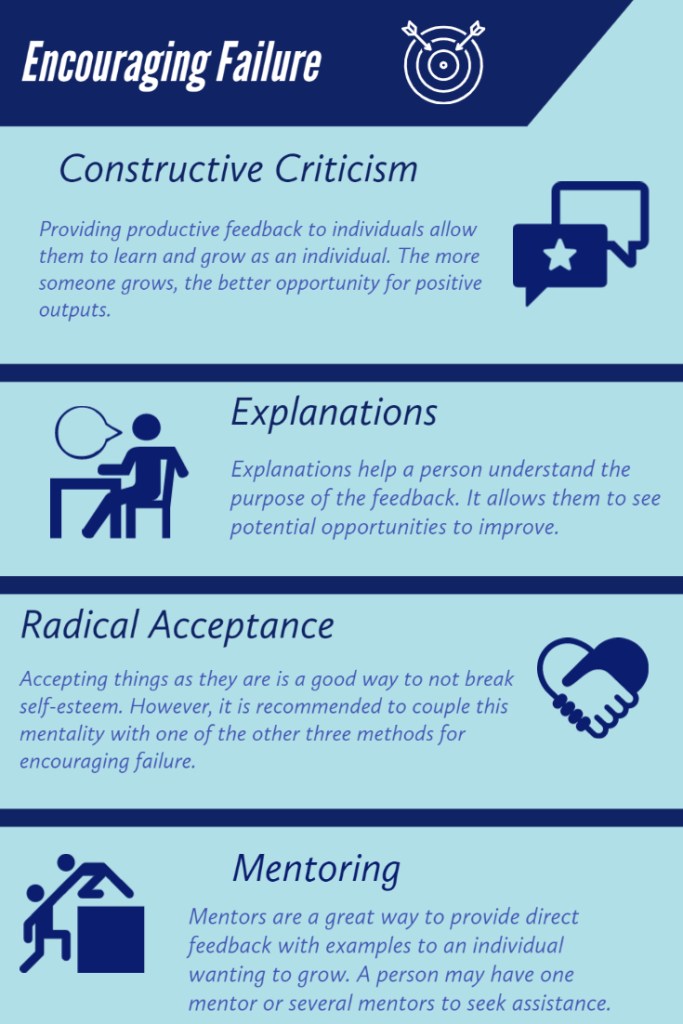
Ways to encourage failure:
- Constructive Criticism: Constructive criticism allows someone to see where they went wrong and how to fix it without their self-esteem being shattered.
- Explanation: Explanations allow someone to understand the why, how, what, etc. This will give them clarity on why someone wasn’t happy about a specific issue.
- Radical Acceptance: Radical acceptance is just accepting something as it is. “It is what it is…” is the best way to describe radical acceptance. It cannot be changed. What is done is done, what is in the past is in the past. However, I would highly encourage pairing this with constructive criticism or explanation.
- Mentoring: Becoming a mentor is underrated, especially in the topic of failure. Mentoring should be something encouraged to allow others to learn from someone who does well in the area in which they are struggling. It could be one person assigned as a whole mentor or multiple people assigned for a variety of topics in need. Mentors are incredibly important to growth.
Failure will always be a part of our life. No one is perfect. Even those that think they are have room to grow. Failure is a part of change and growth. Failure can be overeating, forgetting a blinker at a turn, or not making the score you expected. All of these examples have room for growth if approached the right way.
 Angel Boucher