Most of us grow up not knowing what failure is. When we “fail,” we just keep going or keep trying. We don’t get berated for falling when we try to walk. We don’t get criticized when playing t-ball and miss the hit. Instead, we are taught to keep trying, keep working, and grow from our experience. At times, encouragement is also thrown our way to hope we do better.
Somehow, that changes though as we age. Somehow encouragement turns into negative, non-productive criticism. Keep trying turns into giving up. Self-esteem gets tarnished and hurt. Perfection is expected, even though perfection doesn’t truly exist. A minimum standard becomes a measurement – whether it be weight, grades, time management, etc.
Somewhere along the way, we lose the meaning of what it truly means to fail and the importance of failing.
Childhood Failures Encouraged
During childhood, it is considered a gift to fail. Even though it’s not necessarily called a gift, the idea of it being a gift is there.
When babies first start speaking, they don’t say “mama” or “dada” on their first try. Instead, parents, friends, and other family members giggle, smile, and keep repeating the words in hope to help the baby say “mama” or “dada.” These same people don’t look at the baby with disgust and say, “You can do better. I’m disappointed in you.”
Kids are notorious for lying – intentionally or not. Sometimes it’s a little white lie, while other times it’s quite large. As parents, a discussion is had with the child to encourage telling the truth and explaining the issue with lying. After the discussion, there is hope that there will be a change in behavior for the lying.
As children, it is encouraged to play, make friends, learn new games, and socialize. The more these things occur, the more growth happens. When children don’t play, don’t make friends, and don’t socialize, adults encourage it and sometimes seek assistance to make those areas grow. A concern is given for those who do not play, make friends, learn new games, and socialize.
So why do these expectations turn into negatives?
Adult Expectations
Somewhere around the end of elementary school and beginning of middle school/junior high, society starts to place higher expectations of children. They must make certain grades, they must respect others (especially adults), they must listen to rules, they must stay quiet when spoken to, they must work with others, etc.
It changes from encouragement to expectation. If those expectations are not met, we start to have discussions with children and let them know it’s no longer encouraged, but expected. When these expectations aren’t met, then someone becomes disappointed in them. In turn, it hurts their self-esteem, causing more issues with the encouragement of what they struggled with in the first place.
Continue that through high school where a required ACT/SAT score is needed to get into college and so many credits are required for graduation, placing pressure on an individual to make a specific score. The higher your score, the more likely you’ll get into a college of your choice – whether it be grades of ACT/SAT. Now, that encouragement becomes more pressure based than something out of genuine effort. College just intensifies this.
Students begin to work jobs. There are expectations in jobs. In the beginning, new employees are often “guided” and given constructive criticism about their new job. However, that constructive criticism becomes toxic. It starts off slow with general criticism. Oftentimes, it turns into peers talking about one-another, which in turn breaks the spirit of the employee. Even if this doesn’t occur in front of the person, word eventually gets back around.
In all of these struggles, we forget the gift of failure.
Joys in Failure
What makes failure such a great concept? Why is failure so important? How do we encourage failure in a positive way?
Failure allows people to grow as individuals. It allows them to reflect on what happened, what went wrong, and how to prepare for the future again. Failure creates an atmosphere for continuous growth. Continuous growth is important as a person to ensure we become better. We can become better as a person, as an employee, as a friend, as a mother, as a father, as a sister, as a brother, etc. If we stay stagnant in who we are, we risk losing important people and things around us.
Along with growth, failure allows us to handle criticism better – either from ourselves or others. Failure tells us that sometimes things happen, sometimes we mess up, and sometimes we need help, and that’s okay! Having that guidance allows us to not become broken in our self-esteem, but instead say, “I overcame this,” no matter how big or how small. It breeds self-acceptance in what we are able to handle and what we can learn. A person who thinks they are always right has no room for growth and will never see the value in failure.
Failure also allows us to find ways to never give up. When we fail once, we tend to try again. Failing multiple times, especially in adulthood, we tend to get discouraged. However, if we look as failure as a lesson instead of an action, we can see where growth can occur.
Applying for a job, but not getting the job, because of a bad interview is a learning lesson. We can reflect on why it was bad. Was it the outfit? The noise? The choking during answers? We take time to reflect on the possibilities on the why to make changes for the future.
Not making the sports team can also reflect on a lesson. Did we not make the team due to skill? Teamwork mentality? Conflict in scheduling? Take those lessons and make the necessary changes.
We don’t give up. We learn. We grow.
Change the Mentality of Failure
Failure is so important to the growth of people and society. Without failure, we won’t change, which causes many problems within ourselves and in society. Failure allows us to see the possibilities in what can be. Failure is incredibly important.
As a society, we need to remember what it was like growing up and how failure was encouraged. We should take those tools we experienced as children and promote them into adulthood. It is okay to fail, if we approach it in a way that encourages change. Instead of criticising someone in a negative way, we need to provide ways to encourage the growth that can be produced from failure.
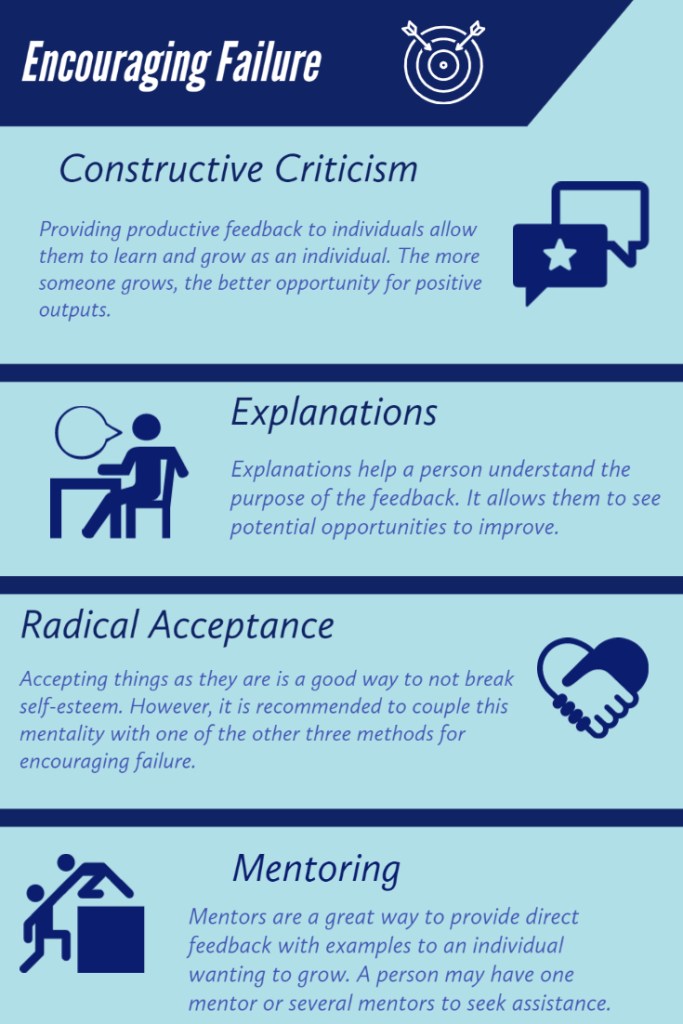
Ways to encourage failure:
- Constructive Criticism: Constructive criticism allows someone to see where they went wrong and how to fix it without their self-esteem being shattered.
- Explanation: Explanations allow someone to understand the why, how, what, etc. This will give them clarity on why someone wasn’t happy about a specific issue.
- Radical Acceptance: Radical acceptance is just accepting something as it is. “It is what it is…” is the best way to describe radical acceptance. It cannot be changed. What is done is done, what is in the past is in the past. However, I would highly encourage pairing this with constructive criticism or explanation.
- Mentoring: Becoming a mentor is underrated, especially in the topic of failure. Mentoring should be something encouraged to allow others to learn from someone who does well in the area in which they are struggling. It could be one person assigned as a whole mentor or multiple people assigned for a variety of topics in need. Mentors are incredibly important to growth.
Failure will always be a part of our life. No one is perfect. Even those that think they are have room to grow. Failure is a part of change and growth. Failure can be overeating, forgetting a blinker at a turn, or not making the score you expected. All of these examples have room for growth if approached the right way.
 Angel Boucher