Tips for New Teachers: What I Wish I Knew

Starting a teaching career can be overwhelming, especially without the support of a comprehensive teacher preparation program. The transition into the classroom often brings anxiety and uncertainty.

My journey was unique. I was assigned two campuses while managing five-course preps. At first glance, this might seem daunting to most, and truthfully, it was a significant challenge. However, this experience provided invaluable lessons. The contrasting cultures and demographics of the two campuses broadened my perspective, and the strong support system at one of the schools played a crucial role in my growth.

Now, fifteen years later, here’s what I wish I had known as a new teacher:

Ask Questions: The Key to Growth as a New Teacher

As a new teacher, you don’t know what you don’t know. The best way to navigate the learning curve is by asking questions—whether to colleagues in your content area, teachers in your hallway, or those with similar teaching experiences. These conversations will provide some of the most valuable insights as you establish yourself in the classroom.

Asking questions is essential to success, from lesson planning and classroom management to scheduling and parent communication. Even after fifteen years in the profession, I continue to seek advice from my peers. Every school has its own culture, and what works in one environment may not be effective in another. If you transition to a new campus, district, or leadership team, take the time to understand the expectations and dynamics of your new setting.

Not Sure What to Ask? Start Here.

To help you navigate your first few months, consider asking:

  • Student Expectations: What are the arrival, dismissal, and transition procedures?
  • Student Demographics: What should I know about our student population?
  • Curriculum & Pacing: Is there a district-mandated curriculum or pacing guide?
  • Technology Resources: What tools are available for teachers and students?
  • Professional Development: What training opportunities are offered?
  • Observations: Am I allowed to observe other teachers on and off campus?
  • Administrator Feedback: How do administrators provide feedback?
  • Campus Routines: What are the key procedures (e.g., CHAMPS, lunch routines, hallway transitions)?
  • Parent Communication: What is the preferred method for contacting parents? Am I required to document interactions?
  • Student Accommodations: How do I track 504 and IEP accommodations, and where is this information recorded?

You’ll gain confidence and build a strong foundation for your teaching career by actively seeking guidance. Never hesitate to ask—every question brings you one step closer to success.

Beg, Borrow, Steal, Adapt, and Train: Learning from Others as a New Teacher

One of the most valuable things you can do as a new teacher is learn from those around you. This includes colleagues within your building, educators from other schools, professional networks, social media, and online teaching resources such as Teachers Pay Teachers. With so many tools and sources of inspiration available, it can feel overwhelming to know where to start.

Recommendations for Expanding Your Knowledge

  • Explore District and Regional Trainings – Contact your district about in-person or digital training opportunities. Many states also have regional education offices that offer professional development for teachers. They may provide additional training options if you’re part of a union. Before enrolling, confirm whether the training counts toward the required professional development hours.
  • Join Webinars for Educational Technology – Many platforms, such as Canva, Nearpod, and IXL, offer free webinars to help teachers maximize student engagement and learning through their tools.
  • Engage with Social Media Communities – Follow experienced educators on Twitter, Instagram, and TikTok. Many share valuable teaching strategies, classroom management tips, and creative lesson ideas, often with real-life implementation examples.
  • Curate and Adapt What Works for You – No single resource or lesson perfectly fits your teaching style, schedule, or classroom structure. Be selective—take what aligns with your needs, modify where necessary, and leave out what doesn’t work. Remember that different schools follow different schedules, such as block scheduling versus shorter class periods, so flexibility is key.

Leveraging the wealth of knowledge from your professional community can help you build a strong foundation and continue evolving as an educator. Teaching is a collaborative profession—embrace the shared wisdom, and don’t be afraid to adjust to fit your unique classroom environment.

Be Yourself: The Power of Authentic Teaching

Authenticity is key to long-term success and reduced stress in teaching. Stay true to your teaching style and preferences. If interactive notebooks aren’t your thing, don’t feel pressured to use them. Teaching should balance innovation and comfort—trying new strategies is valuable, but forcing yourself into methods that don’t align with your style can lead to unnecessary stress. I believe in experimenting with different approaches at least once, but if something doesn’t work for you, it’s okay to let it go. What works for one teacher may not work for another, and that’s perfectly fine.

Building Relationships: The Foundation of Effective Teaching

Strong student relationships are essential for a successful classroom. Dedicate at least the first few days to getting to know your students. These conversations may initially feel surface-level—discussing favorite sports, candy, TV shows, or music—but they serve as a starting point for deeper connections. When asking students about their interests, be sure to share your own—modeling this interaction fosters mutual trust and engagement.

As the year progresses, find ways to incorporate personal connections into your curriculum. This can be done through warm-ups, exit tickets, or content-related discussions. For an English teacher, personal reflections and discussions are naturally woven into lessons, but small moments for connection are possible even in subjects like math. A little effort goes a long way in building trust and rapport.

However, always maintain professional boundaries. Avoid oversharing personal details, and remember that as a teacher, you are a mandated reporter. Some students face challenges far beyond their years; you may hear complex stories. If a student shares something concerning, you must report it appropriately.

By remaining authentic and prioritizing relationships, you can create a supportive and engaging learning environment where you and your students can thrive.

You Are Your Best Advocate

Above all, remember that you are your strongest advocate. Stay true to your values and teaching philosophy, and never lose sight of what matters most. This ties back to authenticity—finding fulfillment in this profession requires staying aligned with your core beliefs and principles.

That said, being true to yourself does not mean imposing personal views or political opinions on students. In many states, doing so is against ethical guidelines. Instead, model the values you believe in through your actions. If family is important to you, foster a classroom environment that feels like a supportive community rather than expecting students to conform to a traditional family structure. If you believe in equality, empower all students to express their perspectives respectfully rather than promoting a singular viewpoint. Demonstrating fairness, inclusivity, and critical thinking allows students to develop their values in an unbiased environment.

Applying these foundational principles can make your first year as a teacher successful. While there are countless strategies to help you navigate this journey, too much advice at once can become overwhelming. Start small, implement changes gradually, and refine your approach over time. Teaching is a lifelong learning process—embrace it with confidence and authenticity.
3 Methods of Modeling in the ELAR Classroom

Modeling in the classroom is vital in pushing students to do their best. As educators, we often strive for perfection in showing students how mechanics should be completed, whether it’s fluency, compression, writing, editing, or revising.

But the reality is that even teachers need to model mistakes in a classroom. It makes teachers human and allows the kids to connect to the teacher and release the pressure of perfection.

1) Write Without Organization

One of the first things I model with my students is brainstorming and writing. I don’t worry about details, paragraphs, word choice, introduction, conclusion, setting, etc. I just write.

Whatever flows from your mind should be processed on paper. You should never try to make the first attempt perfect – not with grammar, spelling, content organization, etc. Students should see you struggle as they would struggle. They should notate any mishaps you have so they don’t initially feel the pressure of perfection.

If you teach middle or high school, you likely have multiple classes. It would help to have an imperfect draft as a model. If you have time, it’s suggested that you write in front of them for every class. One way to spice this up is to create a different prompt for every class so you have multiple stories to tell.

Why is this important?

Sometimes, students feel the pressure to be perfect in their writing, which can cause brain fog. They get so wrapped up in needing all the literary elements that they forget the basics of the story.

Allowing a student to just write freely allows the student to let ideas flow and run through without stress about perfection or judgment. Students who “just write” often have an easier time adjusting their writing and revisiting their content to ensure greater success.

Allowing them to write will also enable students to choose what they want YOU to focus on as a teacher regarding revision. Once the student gets the basic story on paper, you can focus on differentiation through small-group instruction.

If you allow them to write before making a graphic organizer to separate the organization into paragraphs, you allow them to gather their overall thoughts before trying to separate them into big ideas. They can take apart their own essays and place them into “categories,” which become the paragraphs of the paper.

This can also make grading more manageable for you by allowing the student to focus on one thing at a time.

How to implement small group after “just writing”:

Some small groups could be the standards that push students to the next level, which automatically leads to revision:

  • Theme
  • Thesis/Claim
  • Character Development
  • Sensory Detail
  • Introduction/Conclusion
  • Supporting Evidence
  • Use of Text/Graphic Features
  • Organization
  • Setting
  • Word Choice
  • Grammar
  • Conflict-Resolution

2) Marking the Text

When introducing a new concept, it is important to mark the text. This is best done color-coded. I personally enjoy different colored highlighters or colored pencils. I have the students match my colors as much as possible to ensure they have the same notes I do.

How to implement:

For example, when we learn about CER (Claim, Evidence, Reasoning), we use three colors. I like to use blue, red/pink, and green, but any three colors will work. I often do Blue for Claim, Red/Pink for Evidence, and Green for Reasoning.

During the first read of the passage, we just read, think aloud, and process what’s being said. We may pause and discuss chunks, summarize chunks, or find methods to help us “remember” the paragraphs of each section.

On the second read, we often look for the colors, focusing on one at a time. We will discuss what the claim is and how we know it’s the claim. When the claim has been identified, we often discuss the various ways in which the claim can be stated. As we read, we highlight in blue any mention of the claim. We discuss why the author incorporates the claim throughout the passage multiple times, not just at the beginning and end.

On the third read, we focus on the red/pink for evidence. When we discuss evidence, we look for statistics, references, citations, etc. We look for facts about the topic. We avoid opinions, thoughts, and unproven methods. Anytime we see something with evidence, we highlight it in red/pink. From there, we discuss how the evidence supports the claim and why it’s essential to include the evidence for the claim. This brings in a deeper understanding of how authors are intentional about their work.

On the last read, I focused on the green for reasons. Reasons support the evidence, which supports the claim. Reasons are the explanations for why the evidence is important. We draw attention to this to allow students to see the thought process of how the author will support their claim.

Why it’s important:

By color-coding and modeling this, students can see the organization of the paper and better understand the thinking behind the author’s craft.

This gives a visual representation of writing for students. This allows students to see if their own writing mimics the author’s writing and make adjustments as needed. Students can go back to their papers and color-code their papers. If they do not see all three colors, they can revise to help their claim.

This method works for any genre or standard. The important thing is that there is a color-coded key for students to follow and refer back to often to ensure they have a great reference for their own use.

3) One-Pagers

One mistake educators often make is believing students are familiar with certain classroom strategies. Though students may have a concrete background in most strategies, treating each strategy as brand new is essential.

Modeling one-pagers is vital because every person has a different perspective and idea of what a one-pager should look like. The expectations should be drawn out as you grade a student’s one-pager. Sometimes, having a good and a “bad” example will help the student understand the difference. Students don’t need to be artists, so it’s essential to show that they do not need to be by incorporating stick figures, too!

How to implement:

One of the first activities I do at the beginning of the year is a one-pager about myself. On this one-pager, I put information strictly about me there: my interest in reading, writing, cats, traveling, pens, favorite snacks (Skittles, Doritos), shopping (Amazon, Target, Ulta), drinks (water, Coca-Cola, Dr. Pepper), and general information about my family (like two brothers, two nieces, two nephews, etc.).

When I do this, I incorporate different lettering, page breakdowns (how the one-pager is broken up), pictures, colors, and more.

Why it’s important:

This is a great way to build relationships with students and show them expectations about one-pagers. I only make one for this, even if I teach multiple classes because it takes so much time. Sometimes, I will create numerous or add to them each class so the students can see my progress in each class. Having it already created allows me to think aloud with the students on the one-pager and explain why I chose what I did and how it ties to the rubric.

Modeling Doesn’t Stop There

Modeling is incredibly important for students, whether in first grade or eleventh grade. It allows students to see the process in action and process their learning with it. There are millions of ways to model within the classroom. Starting small with one of the methods above is easy and not too time-consuming. It doesn’t require much adjustment.

One of the biggest benefits of modeling is that it allows you to see and feel any possible misconceptions students may have during the creation process. I always told my students, “I never give you anything I haven’t done.” I do this not only to determine misconceptions but also to determine their interest in the topic at hand. If I’m bored, they’re bored.

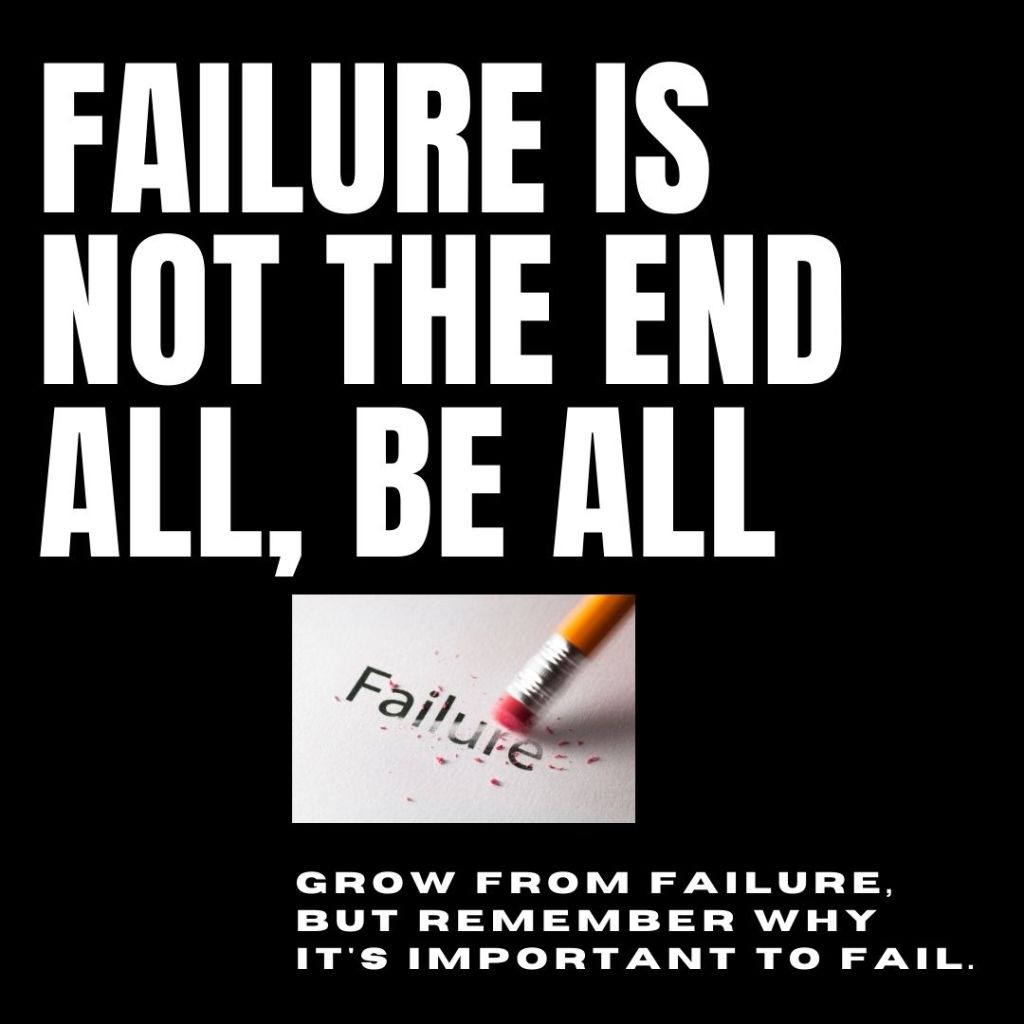
The Gift of Failure – Ways to Encourage Failure

Most of us grow up not knowing what failure is. When we “fail,” we just keep going or keep trying. We don’t get berated for falling when we try to walk. We don’t get criticized when playing t-ball and miss the hit. Instead, we are taught to keep trying, keep working, and grow from our experience. At times, encouragement is also thrown our way to hope we do better.

Somehow, that changes though as we age. Somehow encouragement turns into negative, non-productive criticism. Keep trying turns into giving up. Self-esteem gets tarnished and hurt. Perfection is expected, even though perfection doesn’t truly exist. A minimum standard becomes a measurement – whether it be weight, grades, time management, etc.

Somewhere along the way, we lose the meaning of what it truly means to fail and the importance of failing.

Childhood Failures Encouraged

During childhood, it is considered a gift to fail. Even though it’s not necessarily called a gift, the idea of it being a gift is there. 

When babies first start speaking, they don’t say “mama” or “dada” on their first try. Instead, parents, friends, and other family members giggle, smile, and keep repeating the words in hope to help the baby say “mama” or “dada.” These same people don’t look at the baby with disgust and say, “You can do better. I’m disappointed in you.” 

Kids are notorious for lying – intentionally or not. Sometimes it’s a little white lie, while other times it’s quite large. As parents, a discussion is had with the child to encourage telling the truth and explaining the issue with lying. After the discussion, there is hope that there will be a change in behavior for the lying. 

As children, it is encouraged to play, make friends, learn new games, and socialize. The more these things occur, the more growth happens. When children don’t play, don’t make friends, and don’t socialize, adults encourage it and sometimes seek assistance to make those areas grow. A concern is given for those who do not play, make friends, learn new games, and socialize. 

So why do these expectations turn into negatives?

Adult Expectations

Somewhere around the end of elementary school and beginning of middle school/junior high, society starts to place higher expectations of children. They must make certain grades, they must respect others (especially adults), they must listen to rules, they must stay quiet when spoken to, they must work with others, etc. 

It changes from encouragement to expectation. If those expectations are not met, we start to have discussions with children and let them know it’s no longer encouraged, but expected. When these expectations aren’t met, then someone becomes disappointed in them. In turn, it hurts their self-esteem, causing more issues with the encouragement of what they struggled with in the first place. 

Continue that through high school where a required ACT/SAT score is needed to get into college and so many credits are required for graduation, placing pressure on an individual to make a specific score. The higher your score, the more likely you’ll get into a college of your choice – whether it be grades of ACT/SAT. Now, that encouragement becomes more pressure based than something out of genuine effort. College just intensifies this. 

Students begin to work jobs. There are expectations in jobs. In the beginning, new employees are often “guided” and given constructive criticism about their new job. However, that constructive criticism becomes toxic. It starts off slow with general criticism. Oftentimes, it turns into peers talking about one-another, which in turn breaks the spirit of the employee. Even if this doesn’t occur in front of the person, word eventually gets back around.

In all of these struggles, we forget the gift of failure.

Joys in Failure

What makes failure such a great concept? Why is failure so important? How do we encourage failure in a positive way?

Failure allows people to grow as individuals. It allows them to reflect on what happened, what went wrong, and how to prepare for the future again. Failure creates an atmosphere for continuous growth. Continuous growth is important as a person to ensure we become better. We can become better as a person, as an employee, as a friend, as a mother, as a father, as a sister, as a brother, etc. If we stay stagnant in who we are, we risk losing important people and things around us. 

Along with growth, failure allows us to handle criticism better – either from ourselves or others. Failure tells us that sometimes things happen, sometimes we mess up, and sometimes we need help, and that’s okay! Having that guidance allows us to not become broken in our self-esteem, but instead say, “I overcame this,” no matter how big or how small. It breeds self-acceptance in what we are able to handle and what we can learn. A person who thinks they are always right has no room for growth and will never see the value in failure. 

Failure also allows us to find ways to never give up. When we fail once, we tend to try again. Failing multiple times, especially in adulthood, we tend to get discouraged. However, if we look as failure as a lesson instead of an action, we can see where growth can occur.

Applying for a job, but not getting the job, because of a bad interview is a learning lesson. We can reflect on why it was bad. Was it the outfit? The noise? The choking during answers? We take time to reflect on the possibilities on the why to make changes for the future.

Not making the sports team can also reflect on a lesson. Did we not make the team due to skill? Teamwork mentality? Conflict in scheduling? Take those lessons and make the necessary changes.

We don’t give up. We learn. We grow.

Change the Mentality of Failure

Failure is so important to the growth of people and society. Without failure, we won’t change, which causes many problems within ourselves and in society. Failure allows us to see the possibilities in what can be. Failure is incredibly important. 

As a society, we need to remember what it was like growing up and how failure was encouraged. We should take those tools we experienced as children and promote them into adulthood. It is okay to fail, if we approach it in a way that encourages change. Instead of criticising someone in a negative way, we need to provide ways to encourage the growth that can be produced from failure. 

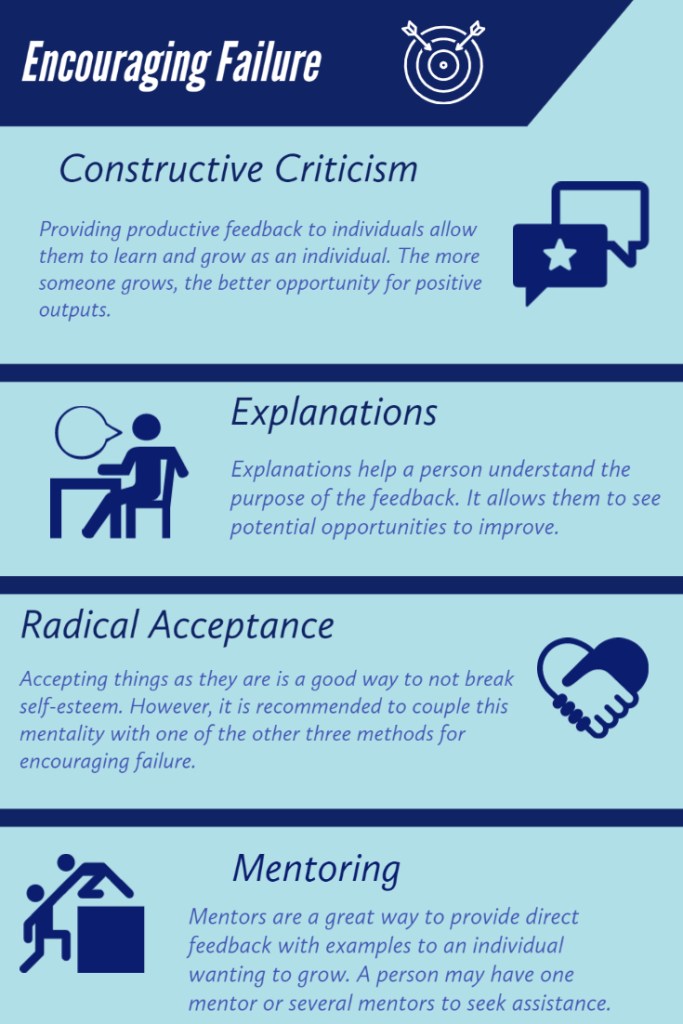
Ways to encourage failure: 

  1. Constructive Criticism: Constructive criticism allows someone to see where they went wrong and how to fix it without their self-esteem being shattered.
  2. Explanation: Explanations allow someone to understand the why, how, what, etc. This will give them clarity on why someone wasn’t happy about a specific issue.
  3. Radical Acceptance: Radical acceptance is just accepting something as it is. “It is what it is…” is the best way to describe radical acceptance. It cannot be changed. What is done is done, what is in the past is in the past. However, I would highly encourage pairing this with constructive criticism or explanation.
  4. Mentoring: Becoming a mentor is underrated, especially in the topic of failure. Mentoring should be something encouraged to allow others to learn from someone who does well in the area in which they are struggling. It could be one person assigned as a whole mentor or multiple people assigned for a variety of topics in need. Mentors are incredibly important to growth. 

Failure will always be a part of our life. No one is perfect. Even those that think they are have room to grow. Failure is a part of change and growth. Failure can be overeating, forgetting a blinker at a turn, or not making the score you expected. All of these examples have room for growth if approached the right way.